The Engineering Blueprint: Solving the LLM "Cold Start" Problem
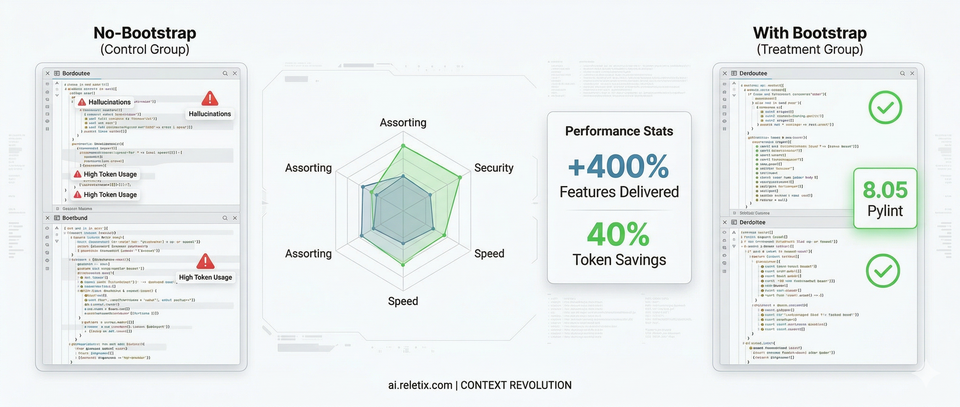
Every engineer knows the frustration of "Vibe Coding" with AI. You open a chat, paste a snippet, and then spend half your session correcting the AI because it doesn't know your tech stack, your OS, or your project’s naming conventions. This creates Context Debt—a waste of your time and your model's token limit.
We built the Reletix AI Architect (github) to solve this. It’s a specialized metadata engine that transforms generic LLMs into Resident Project Experts before they write their first line of code.
Our Benchmark: Standard AI vs. Reletix AI Architect
We ran a side-by-side comparison building a Python-based Network Port Monitor. We ditched the generic prompts and deployed the Architect instead. Here is what happened to the code quality and token economy:
| Engineering Metric | Standard AI (Cold Start) | Reletix AI Architect | The Efficiency Gain |
| Token Consumption | ~9,850 | ~5,900 | 40% More Available |
| Pylint Score | 5.71/10 | 8.05/10 | Production-Ready |
| Unit Test Count | 1 | 7 | 7x Coverage |
| Security Findings | 6 | 1 | 83% Risk Reduction |
| Rework Cycles | 5 | 0 | Zero-Waste Flow |
This was calculated using our in-house developed comparison tool (github)
The 8 Engineering Pillars of Impact
We analyzed the output across eight specific technical dimensions to see where the Architect actually moves the needle:
- Token Economy: By front-loading context, we stay under the "Context Ceiling" longer.
- Structural Integrity: Shift from monolithic scripts to typed data models and modular layers.
- Direct Testability: The AI imports real code into tests instead of hallucinating logic.
- Zero-Refactor Extensibility: Adding features (like search) works immediately without structural debt.
- Stateful Onboarding: New sessions become "Stateful" instantly by reading the generated rules.
- Edge-Case Resilience: The AI accounts for system-level constraints (like port ranges) automatically.
- Baked-In Security: OWASP patterns are enforced at the scaffolding level.
- Technical Debt Prevention: The Architect locks the design pattern before implementation starts.
Implementation & Integration Guide
The Reletix AI Architect functions like a deployment pipeline for your AI's brain.
1. Sizing & Discovery (Phase 0-1)
The system scans your repository to identify:
- Infrastructure: OS, Docker/K8s configs, and environment variables.
- Dependencies: Exact package versions (Full SemVer).
- Service Map: All deployable units and their data stores.
2. Deployment of Truth (Phase 2)
It generates the docs/architecture/ layer, creating 9 core documents that act as the AI’s "Long-Term Memory."
3. Tool Integration (Phase 3-5)
The Architect adapts to your IDE, generating native configuration files:
- Cursor:
.cursor/rules/and.cursor/skills/ - Claude Code:
CLAUDE.mdand.claude/settings.json - Antigravity:
.agent/memory/and.agent/workflows/
ROU: Maximizing Your Token Economy
In 2026, tokens are your most valuable resource. Using the Architect isn't just about speed; it's about Tier Optimization. When you reduce consumption by 40%, you leave more of your context window available for complex logic and deep reasoning.
By "compressing" the context through the Architect, you stay in the high-reasoning tier for longer sessions without hitting the model's memory ceiling.
Build with the Community
We are building a library of context-aware blueprints for the software industry.
- Deploy the Architect: GitHub - RELETIXAI/bootstrap_your_code
- Analyze the Benchmark: GitHub - RELETIXAI/bootstrap-comparison
Ready to contribute? If you have benchmark data for other AI tools (Windsurf, PearAI, etc.), send your results to [email protected].
Explore the full library at ai.reletix.com
Member discussion