The Agent-Native Data Spine
Most teams building agents are one prompt away from a demo and a quarter away from disappointment.
The demo works because the demo asks an easy question. The disappointment arrives later, when the agent has to reason across documents, across time, across the boundary between what someone claimed and what the data actually shows — and quietly gets it wrong, with full confidence. The enemy is not the model. It is the missing layer underneath it: the data the agent reaches for was never built to be reasoned over.
This is the opener for a 22-part series. Before the teardown begins, here is the one idea that ties all of it together — and why every agent you ship lives or dies by it.
The idea: a spine, not a pile
An agent is only as good as the facts it can reach, joined the way the question needs them, valid for the moment it asks, with a trail back to where each one came from. Almost no production stack delivers that. Most deliver a pile of text and an embedding index, then hope the model stitches the rest together at inference time. It can't, reliably — and the failure is invisible until it costs you.
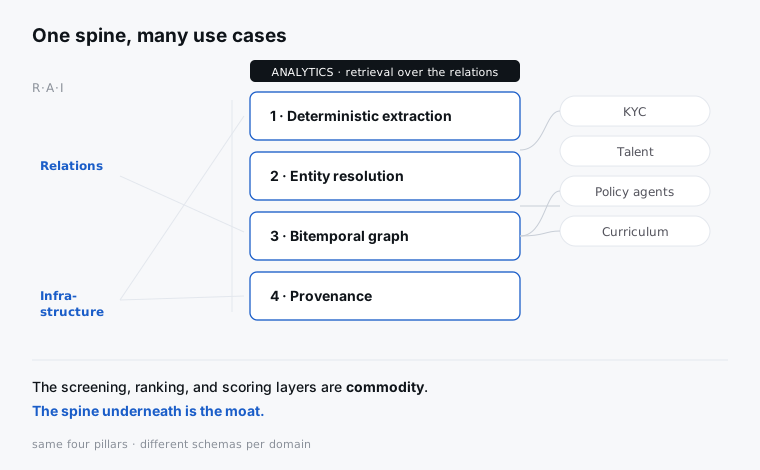
What works instead is a spine: four layers that turn raw documents into facts an agent can actually use. We call it the Agentic Data Spine. It is the same spine whether you are verifying an identity, ranking a candidate, answering over a company's policies, or generating a lesson. The domain changes. The spine does not.
The four pillars
1 — Deterministic extraction. Turn every document into typed, validated, cited facts — not a fuzzy embedding. A name, a number, a date, each one traceable to the exact span it came from, each one checked against a schema before it is allowed into the system. This is the layer that decides whether the facts even arrive. Get it wrong and everything downstream inherits the gap.
2 — Entity resolution. Decide, with a calibrated probability you can defend, when two records refer to the same thing. "Google", "Google LLC", "Alphabet" are one entity or they are three, and your joins silently fail on the difference. This is sixty-year-old, well-understood mathematics that most stacks simply do not apply — and it is the highest-leverage accuracy fix most teams have available.
3 — A bitemporal knowledge graph. Store facts with two clocks: when something was true in the world, and when the system learned it. That second clock is what lets you reconstruct exactly what the agent knew at the moment it decided — the difference between "trust us" and "here is the receipt." The first clock is what makes interval and multi-hop questions native instead of impossible.
4 — Provenance. Every fact carries its origin and its chain of transformations, so a human — or a regulator — can walk any answer back to its source span. Show your work, as a property of the architecture rather than a feature bolted on after the audit request arrives.
Four layers. Each one handles something a vector index cannot. Together they are the difference between an agent that demos and an agent that holds up.
Relations. Analytics. Infrastructure.
RELETIX is named for three words, and the spine is what they mean in practice.
- Relations — the entities and the graph. Who connects to what, what is the same as what, what depends on what. Pillars 2 and 3.
- Analytics — retrieval and reasoning over those relations. Hybrid search, multi-hop traversal, the question actually getting answered. The query layer on top.
- Infrastructure — the pipelines, the extraction, the provenance, the bitemporal store that holds it all up. Pillars 1 and 4.
The series is the long-form version of those three words. Not a slogan — a build sheet.
One spine, many use cases
The reason this matters beyond any single product: the spine is domain-independent.
Verifying an identity for compliance, screening a transaction, ranking a candidate against a role, answering over a company's internal policies without leaking what the user can't see, generating curriculum that respects what a cohort has already covered — these look like different problems. Underneath, they are the same four pillars with different schemas. Extract the facts, resolve the entities, put them in a temporal graph, keep the provenance.
That has a sharp commercial consequence. The layer everyone competes on — the screening score, the match percentage, the ranking — is commodity. It is bought, or it is a thin model on top. The spine underneath is the part that is hard to build, expensive to fake, and defensible once you have it. The moat is not the answer the agent gives. It is the chain of reasoning behind it.
What the 22 parts cover
The thesis behind this series is a long technical document — the north star we draft every article against. The series walks its chapters one at a time, builder-first, with the evidence, the schemas, and the queries you can run yourself.
- Foundations — why naive RAG fails, document understanding beyond OCR, deterministic extraction, entity resolution.
- The graph layer — building the graph, choosing the database, GraphRAG and hybrid retrieval, where vectors actually belong, the lakehouse underneath.
- Validation and truth — making an agent's output defensible, what regulated-data systems already solved, opaque scores versus an interpretable spine.
- Applications — the relationship graph, policy-aware agents that can't read what the user can't, knowledge-to-learning graphs.
- Time and truth — bitemporal knowledge, provenance and audit, evaluation that separates working from demoing.
- Build — the full reference architecture, and where agent-native databases go next.
Each part stands alone. Read end to end, they assemble into one argument: the data layer is the agent.
Where to start
You do not have to take the spine on faith. The fastest way to see the problem is to go find it in your own stack: take a real, multi-hop, time-bounded question, ask your agent, and check the answer by hand. Most stacks miss it and report confidence anyway. That gap is the whole series, and it is where we start next.
The code and the benchmarks live in the open — github.com/RELETIXAI. If you are shipping agents over real data and have learned something the hard way, write to us at [email protected]. We would rather publish one honest report from someone who built it than ten posts from someone who read about it.
Next: why your agents can't actually use your data — the failure nobody demos, measured.
RELETIX AI — Depth over volume. Builders over followers.
Member discussion